- August 16, 2026
- Posted by: admin
- Category: BitCoin, Blockchain, Cryptocurrency, Investments
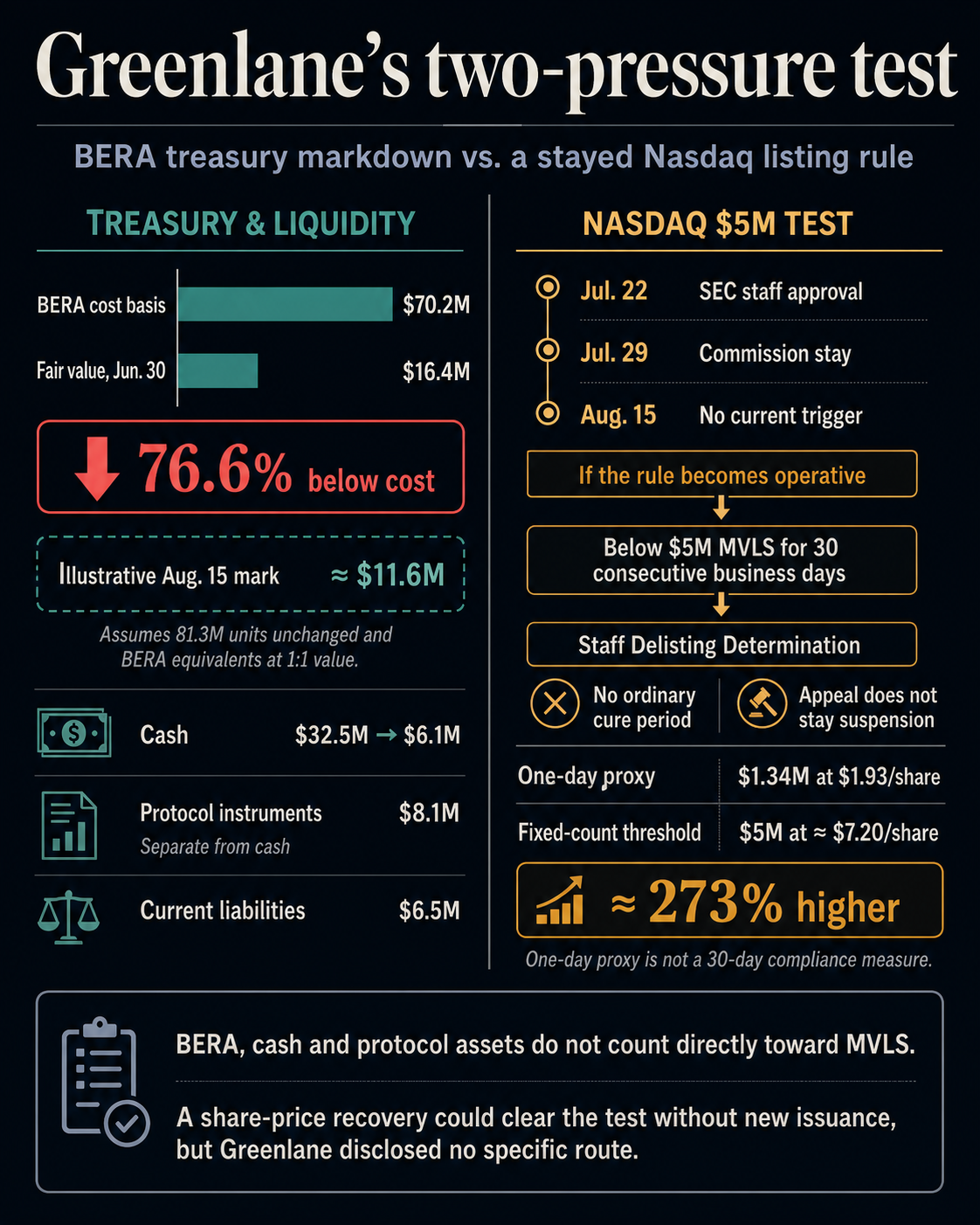
Greenlane Holdings is a Nasdaq-listed company holding about 81.3 million BERA and BERA-equivalent units. Its token treasury ended the second quarter valued at about 77% below cost. A stayed Nasdaq rule could eventually expose the company to a $5 million listing test with no ordinary cure period.
At June 30, the treasury’s $70.2 million cost basis compared with $16.4 million of fair value, according to Greenlane’s quarterly filing. The 76.6% gap was a mark-to-market shortfall, not a realized loss from selling the tokens.
CryptoSlate Berachain market data puts the price at roughly $0.142. At that price, the same 81.3 million units would be worth about $11.6 million. That estimate is illustrative, not a company-reported current value. It assumes the holding was unchanged after quarter-end and that all BERA-equivalent positions value one-for-one.

Greenlane’s liquidity and losses
Greenlane reported $6.1 million of cash at June 30, down from $32.5 million at the end of 2025. In addition, it held $8.1 million of aUSDC and sUSDe protocol instruments, presented separately from cash, against $6.5 million of current liabilities. The filing flags liquidity, redemption, counterparty, protocol and valuation risks around those instruments.
The company’s $24.8 million second-quarter net loss included a $19.1 million noncash change in digital-asset fair value. It also included a separate $1.8 million impairment of its Airgraft investment. Meanwhile, Greenlane’s operating loss was $3.3 million, while cash used in operations totaled about $7.1 million for the first half. These figures separate the accounting hit from cash consumed by the business.
The treasury markdown does not mechanically cause a listing failure. Nasdaq’s Market Value of Listed Securities metric uses the consolidated closing bid price multiplied by listed securities. It does not use the value of Greenlane’s BERA, cash or protocol assets. Nevertheless, those balances matter indirectly because they can affect investor valuation and the company’s financing options.

A stayed rule with no ordinary cure
The SEC approved Nasdaq’s new $5 million MVLS requirement on July 22. The Commission stayed that approval on July 29 while it reviews the decision. The official SEC docket showed no later merits order or timetable as of Aug. 15.
The rule therefore creates no current trigger for Greenlane. If it becomes operative, however, 30 consecutive business days below $5 million in MVLS would produce a Staff Delisting Determination. That process would not include the ordinary compliance period used for many listing deficiencies. A hearing request would not stay trading suspension. A panel could reverse an error or allow up to 180 days to meet all applicable initial-listing standards. That is not a standard cure period.
Greenlane said that, as of Aug. 14, it would be below the threshold without the stay. It had received no deficiency notice or Staff Delisting Determination and was evaluating unspecified alternatives to increase MVLS.
Using Greenlane’s disclosed 694,544 shares and its $1.93 Aug. 13 close gives a one-day proxy of about $1.34 million. With that share count fixed, $5 million would require roughly $7.20 per share, about 273% above $1.93.
Separately, a dilutive raise is not mathematically required. A sufficient share-price recovery could lift MVLS without issuing stock. For that reason, at the disclosed share count, clearing the threshold would require that steep price increase. Greenlane disclosed no specific route, and a single day’s price cannot establish a 30-business-day compliance result.
The post How a public firm’s $70 million altcoin bet crashed 77% and left it facing Nasdaq delisting appeared first on CryptoSlate.