- January 27, 2026
- Posted by: admin
- Category: BitCoin, Blockchain, Cryptocurrency, Investments
SharpLink CEO Joseph Chalom, who previously led BlackRock’s digital assets strategy, framed the Ethereum-versus-Solana debate as a mismatch between narrative and actual institutional behavior: TradFi firms may praise speed and low fees, but the highest-value financial use cases are gravitating to networks optimized for trust, security, and liquidity.
Why Ethereum Beats Solana
Speaking with CoinDesk’s Jennifer Sanasie on Jan. 26, Chalom said he would avoid positioning his view as opinion and instead point to what he called observable market signals. “Maybe I’ll just share facts,” he said. “The fact is that Ethereum has been around for 10 years. It’s the secure, trusted, and liquid ecosystem. And I talk about both the layer 1 mainnet as well as the long set of layer 2s who help do that rollup strategy.”
That longevity, in his telling, matters because institutions aren’t selecting chains the way consumers pick apps. They’re selecting settlement rails for moving money, tokenizing assets, and representing ownership, workflows where operational failure and security assumptions are existential. Solana, Chalom acknowledged, has carved out a reputation for performance. But he drew a hard line on reliability. “Solana has been fast and cheap but it has not been secure. It has had downtime,” he said, arguing that downtime risk is disqualifying for “high value projects.”
Chalom’s thesis is that when the use case is “tokenizing assets” and “moving money,” the decision criteria compress into three buckets. “The real institutions who care only about three things,” he said, are “trust, security, and liquidity.” On that basis, he argued, “they’re building on Ethereum for high value projects,” adding: “It’s happening on Ethereum.”
He also anchored the comparison in stablecoin and tokenized-asset activity, citing a sharp share gap as evidence of where the market is allocating serious volume. “More than 65% of stablecoins and tokenized assets are happening there,” Chalom said, describing that as “10x what you see on Salana.” He reinforced the directional claim immediately after: “Ethereum leads in high quality assets in DeFi, tokenization, and stable coins by a factor of 10 to one over Salana. And that gap is only getting larger.”
Still, Chalom did not argue for a single-chain world. Instead, he mapped Ethereum and Solana to different product surfaces based on security tolerance. “I do think there’s a role for cheap, fast, less secure chains,” he said, and suggested Solana’s comparative advantage shows up where finality speed and cost trump institutional-grade assurances. “I think Solana will win in the memecoin, maybe the gaming space where actually security matters a lot less and speed matters more.”
The subtext is a segmentation story: Ethereum as the default rail for high-value, regulated, reputation-sensitive flows; Solana as the venue for high-throughput consumer and speculative activity where users accept different risk tradeoffs. Chalom insisted this is not about persuasion so much as migration patterns. “It’s not my perspective,” he said. “People are voting with their feet.”
Notably, SharpLink Gaming (Nasdaq: SBET) has emerged as one of the largest corporate ETH holders, with public trackers putting its holdings at roughly 864,840 ETH (about $2.5B at recent marks).
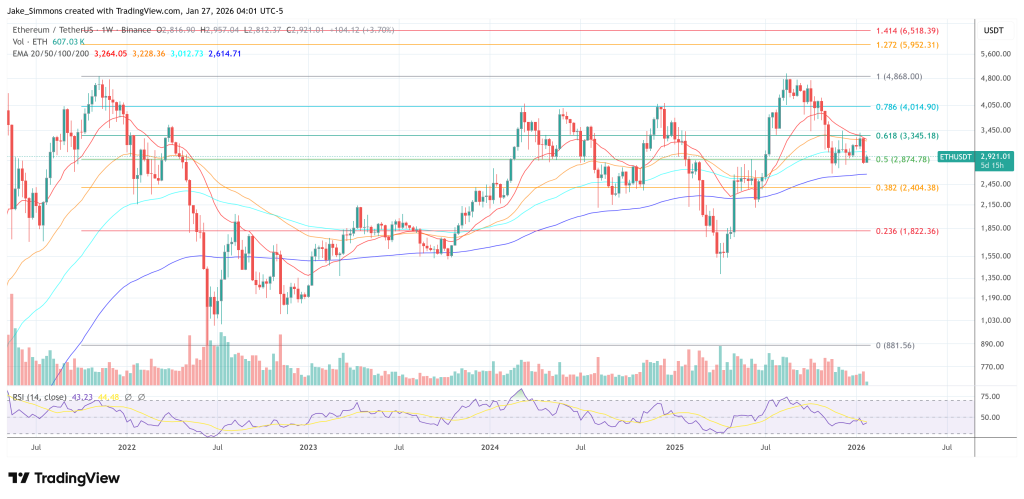
At press time, ETH traded at $2,921.