- March 31, 2026
- Posted by: admin
- Category: BitCoin, Blockchain, Cryptocurrency, Investments
Senate Banking is targeting the second half of April for a markup of the Digital Asset Market Clarity Act, with Easter recess running through Apr. 13.
Senator Cynthia Lummis publicly confirmed the timetable, and Senator Bernie Moreno put the deadline plainly: missing the Senate floor by May could push serious digital asset legislation beyond the 2026 midterm cycle and close the window.

The five-step route from Banking Committee markup to floor vote, conference with the Agriculture Committee version, final passage, and presidential signature compresses the bill’s timetable into a few weeks.
The stablecoin yield dispute that canceled the January markup now has a resolution in principle.
Senators Thom Tillis and Angela Alsobrooks reached a deal that Lummis described as 99% resolved. The framework would bar passive yield on held stablecoins while allowing activity-based rewards tied to payments, transfers, wallet use, and similar functions.
Alsobrooks described the compromise as one that would leave both sides “just a little bit unhappy.”
Senators still need to resolve new complications regarding community bank deregulation, ethics provisions for crypto-linked officials, and the treatment of DeFi before they can lock in the markup text.
The House passed CLARITY 294-134 in July 2025, and the GENIUS Act became law on the same month. The White House established the Strategic Bitcoin Reserve by executive order in March 2025.
The SEC and CFTC jointly clarified the treatment of crypto on Mar. 17. Together, those moves show the US building a policy stack that sorts digital-asset models by how well they fit within the American financial system.
| Date | Event | What it added to the policy stack |
|---|---|---|
| July 2025 | House passes CLARITY, 294–134 | Put a federal market-structure framework on record in one chamber |
| July 2025 | GENIUS Act becomes law | Created the federal stablecoin framework and narrowed stablecoins toward payments utility |
| March 2025 | White House establishes the Strategic Bitcoin Reserve by executive order | Gave Bitcoin formal policy symbolism inside the U.S. digital-asset agenda |
| March 17, 2026 | SEC and CFTC jointly clarify crypto treatment | Reinforced the commodity/securities sorting logic behind CLARITY |
| Second half of April 2026 target | Senate Banking markup | Opens the path for the Senate to close the largest remaining legislative gap |
| May 2026 urgency window | Senate floor deadline, per the article’s framing | Compresses the bill’s path into a narrow political window |
CLARITY would close the largest legislative gap in that architecture, and Bitcoin sits at the top of that hierarchy.
Senate Banking’s own framing says the bill would draw a bright line between digital asset securities and digital asset commodities, replace regulation-by-enforcement with a rule-based regime, and give the CFTC authority over spot markets for non-security digital assets.
Bitcoin already occupies the commodity lane in market convention, court rulings, and political symbolism. CLARITY would give that position statutory backing and deepen the Strategic Bitcoin Reserve’s policy weight.
What the stablecoin squeeze does for Bitcoin
The stablecoin architecture now taking shape points toward a payments utility.
The GENIUS Act requires 100% reserve backing, monthly disclosures, and marketing rules that bar misleading claims about government backing, insurance, or legal-tender status.
Section 404 of the Senate CLARITY draft bars digital asset service providers from paying interest or yield solely for holding a payment stablecoin and blocks any marketing that frames stablecoin compensation as deposit-like, FDIC-insured, or risk-free.

Activity-based rewards tied to transactions and platform participation stay on the table. The familiar pitch of holding a dollar-pegged token and collecting yield sits outside what either law authorizes.
That framework reshapes Bitcoin’s narrative position. As Congress channels stablecoins toward regulated payments plumbing, Bitcoin stands out more clearly as the investable risk asset in US crypto markets.
Stablecoins see increased transaction volume and utility within the framework. They lose the quasi-savings economics that could otherwise compete for capital alongside a long-term Bitcoin position.
The market already priced that asymmetry in real time. Circle suffered a 20% selloff when the stablecoin reward-restriction language surfaced.
Coinbase’s stablecoin revenue reached $364.1 million in the quarter ended Dec. 31, 2025, while Circle’s reserve-income-linked business drove the bulk of its results. Traders treated the compensation limits as a direct hit to those business models.
Bitcoin’s value proposition runs through scarcity and commodity demand, a model Congress is leaving intact.
CoinGecko shows Bitcoin accounting for roughly 56% of the total crypto market capitalization, with stablecoins at about 13%.
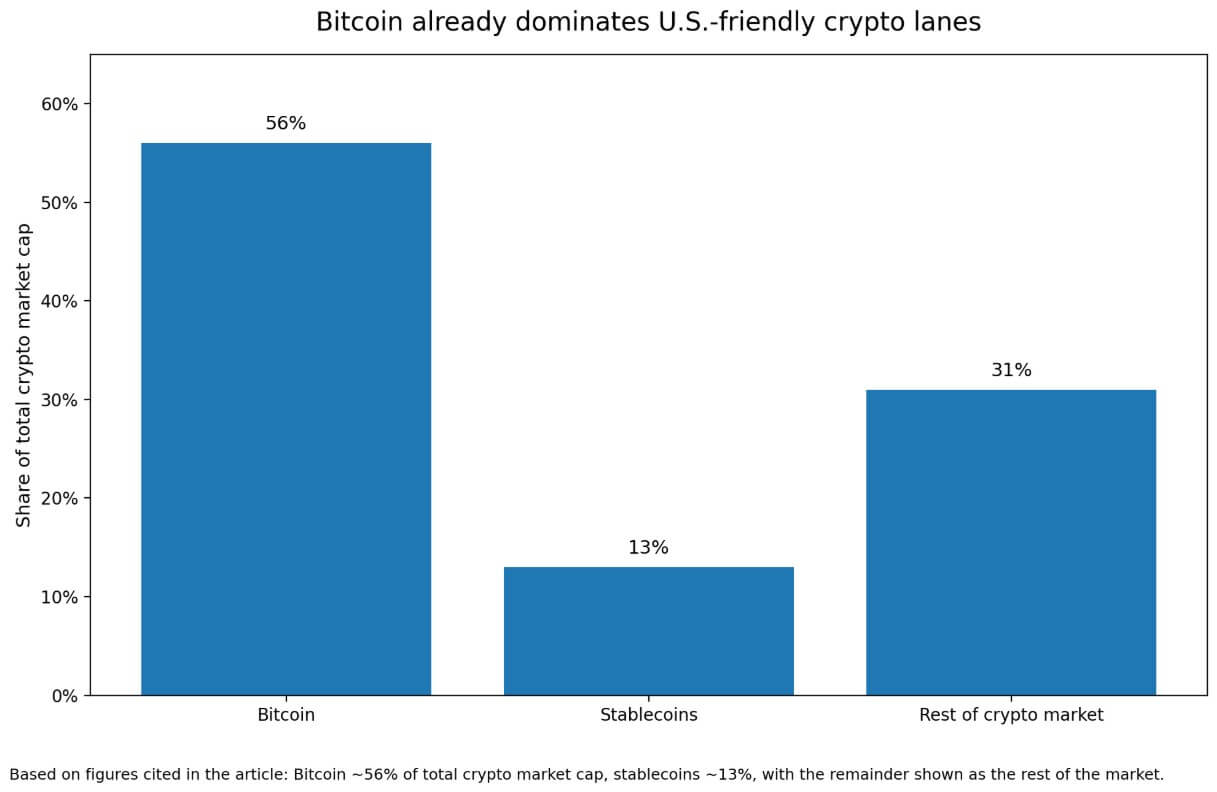
JPMorgan analysts called CLARITY passage by midyear a positive catalyst for digital assets, citing regulatory clarity and institutional scaling. Polymarket placed 2026 signing odds at 72%.
Those readings show a market that expects a cleaner commodity designation to give institutions a cleaner rationale for Bitcoin exposure and to formalize a dominance structure already in place.
What a markup represents
In the bull case, Senate Banking marks up the bill in late April, and the full Senate treats it as the closing chapter of a coherent US digital asset framework.
Institutions read the SEC/CFTC bright line as a mandate to classify Bitcoin as a commodity for custody, portfolio construction, and product approval.
Bitcoin’s market cap dominance extends from the mid-50s toward the 60% range as capital concentrates in the asset with the clearest legal and political fit. Stablecoins keep expanding as a payments infrastructure.
Congress constrains its yield economics while preserving its transaction utility. Altcoins gain process clarity and lose the gray-area optionality that once let projects defer classification.
| Category | Bull case | Bear case |
|---|---|---|
| Bitcoin | Gains the clearest legal and political fit as a commodity asset; market-cap dominance moves from the mid-50s toward the 60% range | Still outperforms relative to the rest of crypto, but the broader market reads CLARITY as selective rather than broadly bullish |
| Stablecoins | Keep expanding as payments infrastructure under a clearer federal regime | Grow in utility but lose the economics that made them attractive as yield-linked products |
| Stablecoin-linked equities | Benefit from long-term legal certainty and institutional adoption of regulated stablecoin rails | Stay under pressure because reward and compensation limits cut into core business models |
| Altcoins | Gain process clarity and a cleaner route to classification and compliance | Face tighter disclosure and intermediary standards that favor incumbents over smaller projects |
| Exchanges and intermediaries | Operate inside a more legible rulebook that supports institutional participation | Lose a marketing tool tied to stablecoin rewards and face a heavier compliance burden |
| Institutional adoption | Gets a cleaner rationale for Bitcoin exposure, custody, and product approval | Stays selective, concentrating first around Bitcoin and the most compliance-ready parts of the market |
| Overall market structure | Formalizes a U.S. hierarchy: stablecoins for payments, Bitcoin for investable exposure, other crypto deeper in the compliance funnel | Produces an uneven market where Bitcoin gains legitimacy faster than the rest of the sector |
In the bear case, CLARITY passes and distributes the benefits unevenly. Stablecoin-linked equities stay under pressure because compensation limits cut directly into business models built around yield sharing. Exchanges lose a marketing tool.
Altcoin projects face disclosure obligations and intermediary standards that favor incumbents over new entrants. Bitcoin outperforms on a relative basis while the broader crypto complex trades sideways or weaker.
The Circle selloff already offered a preview of how fast that separation can show up in the market.
Each outcome points to the same destination: Bitcoin exits the process in a stronger position than the rest of the market. If CLARITY passes, Washington will have chosen which crypto asset gets to look legitimate first, and Bitcoin holds the strongest claim to that role.

The post CLARITY Act deadline in weeks could kill stablecoin earnings and push money into Bitcoin appeared first on CryptoSlate.