- June 10, 2026
- Posted by: admin
- Category: BitCoin, Blockchain, Cryptocurrency, Investments
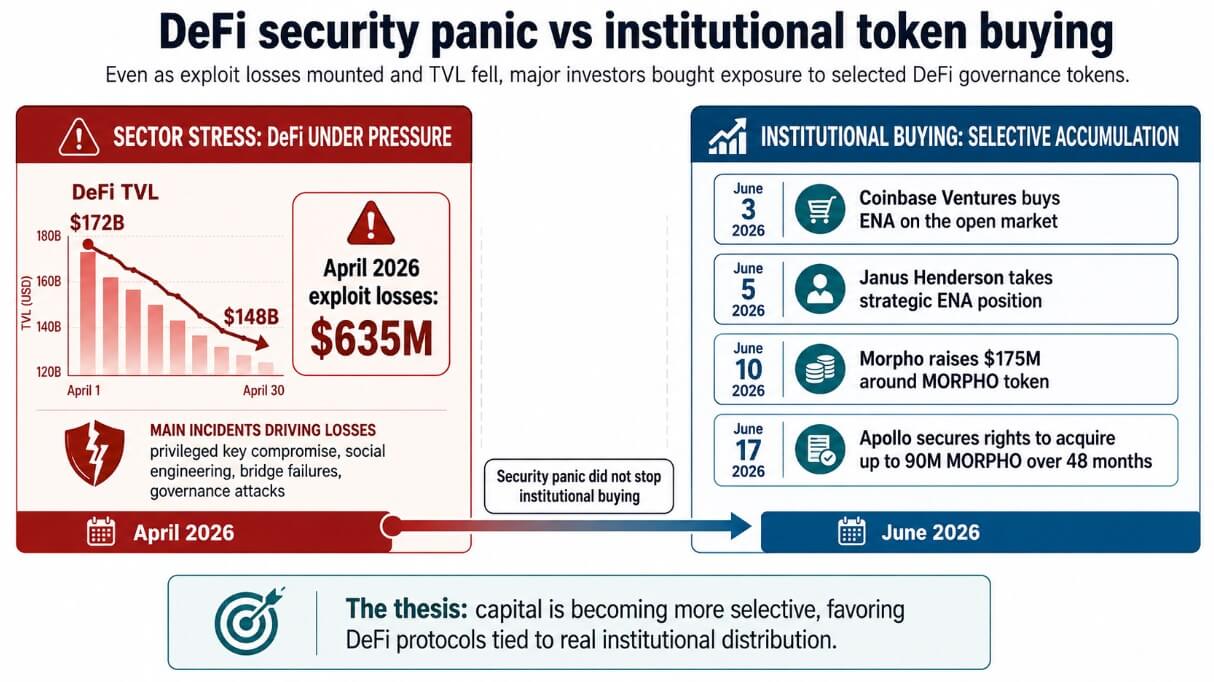
The total value locked (TVL) on DeFi fell from $172 billion to $148 billion as the sector logged $635 million in exploit losses across April alone. Coinbase Ventures bought Ethena’s ENA token on the open market, Janus Henderson took its own strategic ENA position, and Morpho closed a $175 million round structured entirely around the MORPHO token.
Apollo separately secured rights to acquire up to 90 million MORPHO tokens over 48 months.
The bet these investors are making is that governance tokens attached to DeFi protocols with real institutional distribution will rerate as financial infrastructure, and that the security panic accelerates that outcome by flushing weaker protocols out of the running.
The infrastructure bet
Morpho reports $11 billion-plus in deposits and counts Bitwise, Galaxy, Anchorage Digital, Coinbase, Kraken, and Binance among its institutional users.
Apollo’s token acquisition agreement was capped at 90 million MORPHO over 48 months with transfer and trading restrictions, structured through open-market purchases, OTC transactions, or other contractual arrangements.
Fortune reported the $175 million raise valued the protocol at up to $2 billion, a figure derived entirely from the token’s market value.
ENA sits at the governance layer of a synthetic-dollar protocol being routed through Coinbase’s 100 million-plus users, where Coinbase already serves as Ethena’s primary custodian, wallet provider, and perpetuals venue.
Meanwhile, Janus Henderson pairs its ENA position with plans to use USDe for treasury cash management and to explore tokenized CLO collateral through its and Centrifuge’s infrastructure.
With the 10-year Treasury yield around 4.55% and a Fed target range of 3.50%-3.75% that most economists expect to hold through the rest of 2026, stablecoin yield, tokenized Treasuries, and on-chain credit markets carry the kind of economic relevance that makes these positions legible to traditional asset managers.
USDe’s market cap sat at roughly $4.5 billion, up 13% over 30 days, while ENA itself traded near $0.08 with a market cap of around $750 million.
| Protocol / token | Infrastructure exposure | Institutional links | Key adoption metric | Token caveat |
|---|---|---|---|---|
| Ethena / ENA | Synthetic dollar, stablecoin yield, collateral, treasury cash management | Coinbase, Janus Henderson, Anchorage | USDe market cap around $4.5B, up 13% over 30 days | ENA price near $0.08; adoption has not clearly translated into token rerating |
| Morpho / MORPHO | Onchain lending, credit markets, vault infrastructure | Apollo, Paradigm, a16z, Circle Ventures, VanEck, Coinbase, Kraken, Binance | $11B+ deposits; $6.43B TVL; $3.43B active loans | Governance rights do not equal equity, cash-flow claims, or legal ownership |
Why security panic sharpens the thesis
The April incident wave spanned compromised privileged keys, social engineering, bridge failures, governance surface attacks, and external dependencies.
Protocols with institutional distribution, professional custody integration, transparent collateral structures, and genuine demand from exchanges and asset managers carry a different risk profile.
If capital keeps repricing DeFi’s weakest tier downward, the protocols already embedded in institutional workflows absorb the flows leaving weaker venues.
Janus Henderson, Apollo, Circle Ventures, and VanEck each built positions in DeFi infrastructure tokens as security fears accelerated the separation between protocols tied to real institutional demand and those DeFi TVL figures have historically tracked, with capital growing more selective about which rails it trusts.
ENA and MORPHO give holders governance rights over the protocols, with ownership of Ethena Labs or the Morpho Association, legal claims to cash flows, and control over assets, all outside what either token conveys.
Betting on these tokens works only if adoption translates into token demand, governance relevance, or credible value capture.
DefiLlama shows Morpho Blue generated roughly $39 million in gross protocol revenue in the second quarter, with $3.43 billion in active loans against $6.43 billion TVL flowing to liquidity providers and vault curators.
Coinbase and Janus Henderson provide Ethena with a distribution that most DeFi protocols cannot access, and USDe’s market cap grew roughly 13% over 30 days to about $4.49 billion.
Yet ENA traded down roughly 10% on the day of the Janus announcement, with the token near $0.08 and market cap around $750 million.
Buyers of ENA are taking a position on a convergence between institutional adoption and token value that the market has yet to price in.
The next cycle’s shape
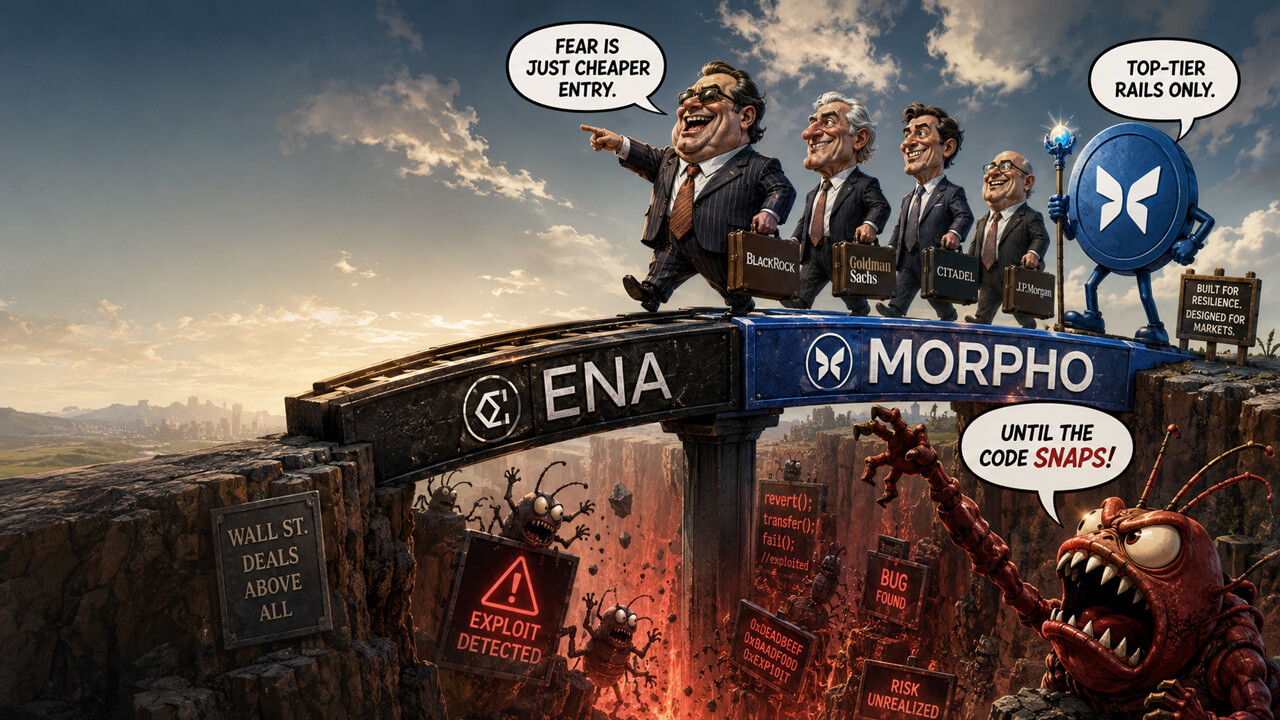
If Coinbase, Janus Henderson, Apollo, Circle, and VanEck normalize DeFi-backed cash and credit products through their existing channels and security panic keeps concentrating capital into top-tier protocols, ENA and MORPHO rerate as governance assets over infrastructure processing real institutional volume.
USDe would then retest a significantly larger supply base, and Morpho deposits would move toward $18 billion and $25 billion, with both tokens trading as strategic assets with a claim on the rails beneath them.
If another major exploit, depeg event, or regulatory restriction pauses institutional distribution, governance token ownership proves it was always decoupled from protocol economics.
In this scenario, USDe supply would fall by 30% to 50%, MORPHO would sell off despite continued protocol usage, and the disconnect between holding governance rights and capturing value from the protocol would remain wide.
| Scenario | What happens | USDe / ENA implication | Morpho / MORPHO implication | Bigger takeaway |
|---|---|---|---|---|
| Bull case | Institutional distribution expands and security panic concentrates capital in top protocols | USDe retests a larger supply base; ENA rerates as governance over synthetic-dollar infrastructure | Deposits move toward $18B–$25B; MORPHO trades as strategic governance exposure | Governance tokens become infrastructure assets |
| Bear case | Major exploit, depeg, or regulation pauses adoption | USDe supply falls 30%–50%; ENA remains disconnected from adoption | MORPHO sells off despite continued protocol usage | Token ownership remains decoupled from protocol economics |
| Base case | Adoption grows, but token value capture remains uncertain | USDe grows, but ENA repricing is uneven | Morpho usage rises, but value accrual stays unclear | Infrastructure wins, tokenholders may not |
| Black swan | Core protocol, custody, collateral, or governance failure | ENA loses infrastructure premium | MORPHO governance becomes a liability | The “trusted rails” thesis breaks |
Apollo, Paradigm, a16z, Janus Henderson, and Coinbase Ventures each made a separate bet that the rails they chose would carry enough institutional volume to make governing those rails worth holding.
Whether token ownership closes the distance with the economic value flowing through the protocols beneath it is the cycle’s actual open question.
The post Wall Street is buying DeFi tokens again, even as everyone worries the code is unsafe appeared first on CryptoSlate.