- March 16, 2026
- Posted by: admin
- Category: BitCoin, Blockchain, Cryptocurrency, Investments
A new fault line is opening in the Bitcoin mining debate as AI data centers emerge as a far richer buyer of electricity than traditional miners. But the argument over whether that dynamic threatens Bitcoin’s long-term security is drawing a sharp pushback from market and energy specialists who say the headline claim misses how mining economics actually work.
The flashpoint came from Crypto Banter co-founder Ran Neuner, who framed the issue in stark terms. “AI has killed Bitcoin forever. It became Bitcoin mining’s biggest competitor. Not another crypto. AI,” he wrote on X, arguing that both sectors are chasing the same scarce input: power.
Neuner’s basic math is simple and provocative. He claimed BTC mining generates roughly $57 to $129 of revenue per megawatt, while AI data centers can make $200 to $500 per megawatt from that same electricity.
“That’s why miners are starting to pivot,” he wrote, pointing to Core Scientific’s AI hosting deal, Hut 8’s $7 billion AI infrastructure agreement, and Cipher Mining’s decision to cut hashrate 51% to focus on AI compute. From there, he pushed the key question: if AI becomes the highest bidder for power, what happens to Bitcoin?
That framing resonates because it captures something real: miners are no longer competing only with other miners. In certain markets, they are competing with hyperscale-style compute demand that may support a much higher revenue profile. For listed mining firms, especially those already sitting on power infrastructure, the temptation to repurpose capacity for AI is obvious.
Why AI Won’t Kill Bitcoin Mining
But on-chain analyst Willy Woo argued that Neuner’s conclusion confuses miner competition with network-level economics. “What the BTC network is willing to pay for its security is set the BTC price and network use,” Woo wrote. “The price of electricity is irrelevant, that only impacts competition between miners. Study BTC’s difficulty adjustment – it’s a fundamental cornerstone of understanding BTC.”
That is the core rebuttal. Bitcoin does not require every miner to remain profitable at every electricity price. It adjusts. If higher-cost operators drop off because AI outbids them for power, mining difficulty can fall, allowing the remaining miners to continue operating under a new equilibrium. In Woo’s reading, AI may reshuffle who mines and where, but it does not automatically “kill” Bitcoin unless it permanently breaks the relationship between price, usage, and the network’s security budget.
Climate-focused venture capitalist Daniel Batten pushed back even harder, calling the thesis “Nonsense” and arguing that the relationship may increasingly run in the other direction. “It’s the other way around: the evidence tells us that AI is dependent upon Bitcoin for its expansion,” he wrote. “For example, bitcoin mining can be used alongside AI for strategic advantages including monetizing energy during AI datacenter construction, using forward-purchased energy that would otherwise be wasted, [and] smoothing demand patterns of AI load.”
Be very skeptical of any claims such as “Bitcoin mining is unprofitable beyond this threshold” or “AI is killing Bitcoin”.
Not only is it more nuanced than that, but the research tells us that AI datacenters increasingly need Bitcoin mining (see 7. below)
For example
1. In… pic.twitter.com/G5UvbTUmCc— Daniel Batten (@DSBatten) March 15, 2026
Batten’s broader point is that blanket claims about mining profitability flatten a business with highly variable inputs and revenue streams. He argued that miners in high-cost regions can still operate because heat recycling may be the primary revenue source and BTC the byproduct. Others increasingly own generation assets, mine on intermittent power, or tap stranded energy from oil, gas, and landfills at roughly 1 cent per kilowatt-hour in exchange for higher upfront capex. Demand response programs, FCAS, RECs, and carbon credits can further change the economics.
He also stressed that negative power prices during renewable surpluses create openings that generalized “AI beats mining” comparisons fail to capture. “Be very skeptical of any claims such as ‘Bitcoin mining is unprofitable beyond this threshold’ or ‘AI is killing Bitcoin’,” Batten wrote. “Not only is it more nuanced than that, but the research tells us that AI datacenters increasingly need Bitcoin mining.”
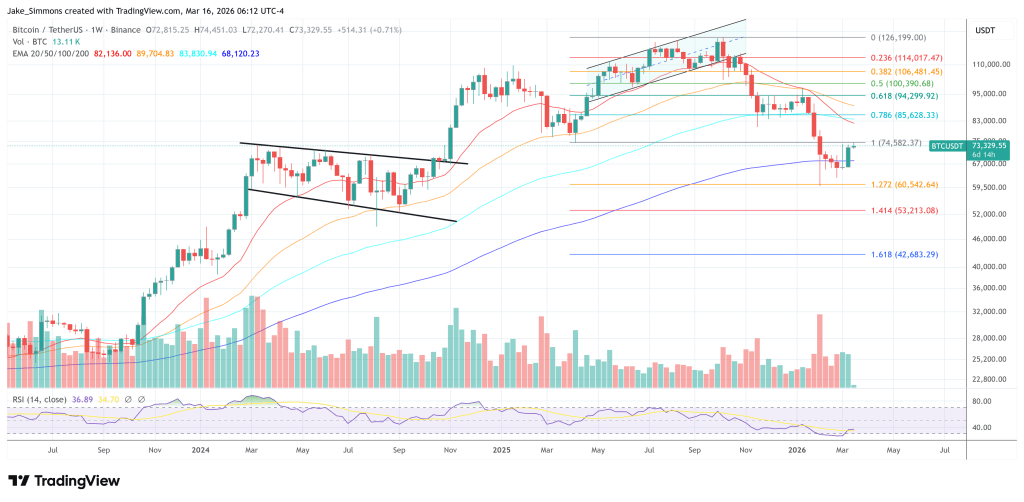
At press time, BTC traded at $73,329.